
Duolingo Offline Course
Fast, focused prep for the Duolingo English Test — accepted by thousands of universities worldwide.
Chat on WhatsAppWhy choose Ambrits for the Duolingo English Test
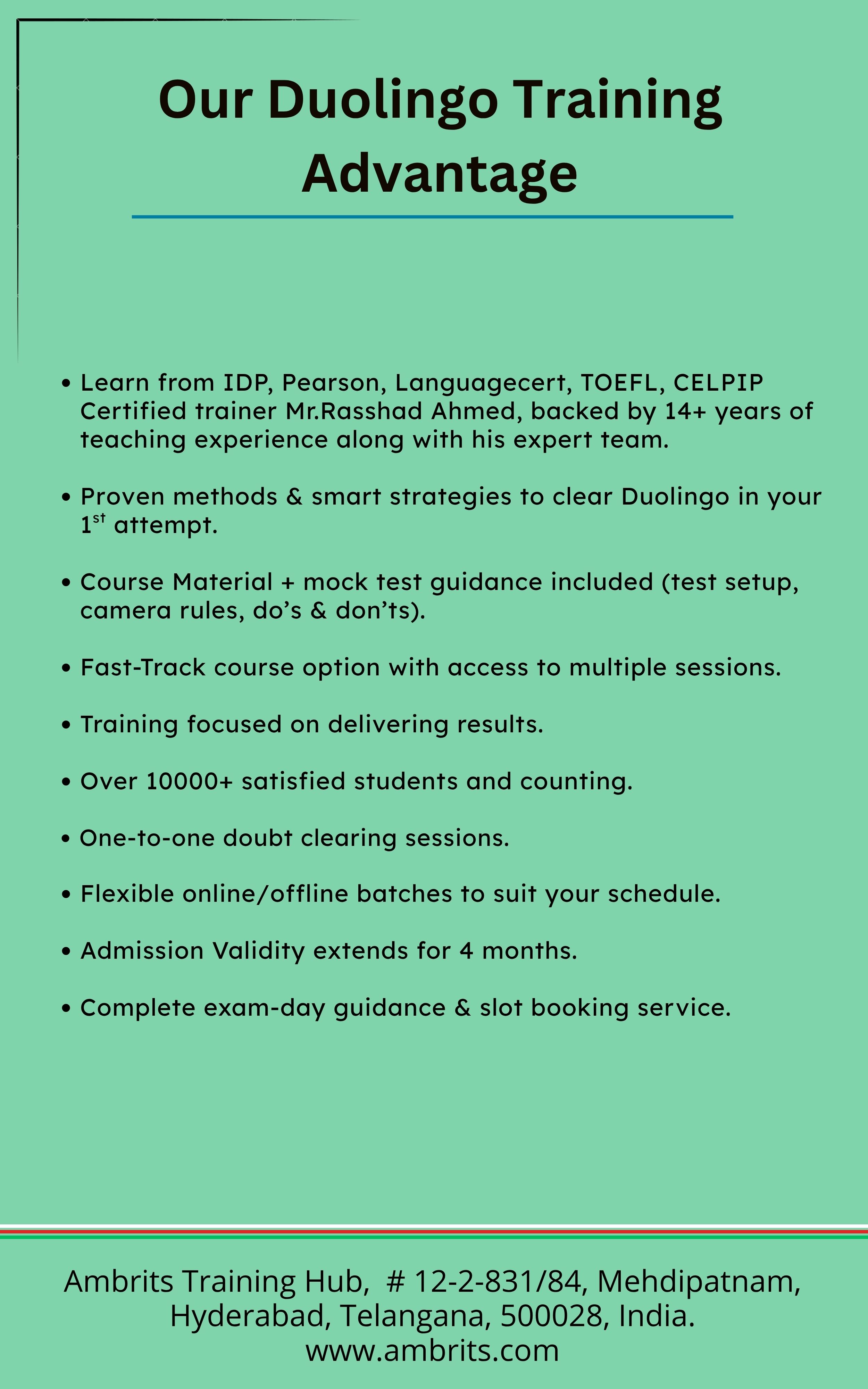
Learn from trainer Rasshad Ahmed, certified across IDP, Pearson, LanguageCert, TOEFL and CELPIP with 14+ years of teaching experience. Proven methods and smart strategies help you clear the Duolingo English Test in your first attempt — over 10,000 satisfied students and counting.
What’s covered
- All test sections — reading, writing, listening and speaking, matched to the Duolingo test’s actual question formats.
- Adaptive-format strategy — how to pace yourself as question difficulty shifts through the test.
- Complete at-home test guidance — test setup, camera rules, and dos and don’ts for the proctored exam environment.
- Course material + mock test guidance — included as part of the course.
What’s included
- Course material + mock test guidance (test setup, camera rules, do’s & don’ts)
- One-to-one doubt clearing sessions
- Flexible online/offline batches to suit your schedule
- Admission validity extends for 4 months
- Complete exam-day guidance & slot booking service
Course details
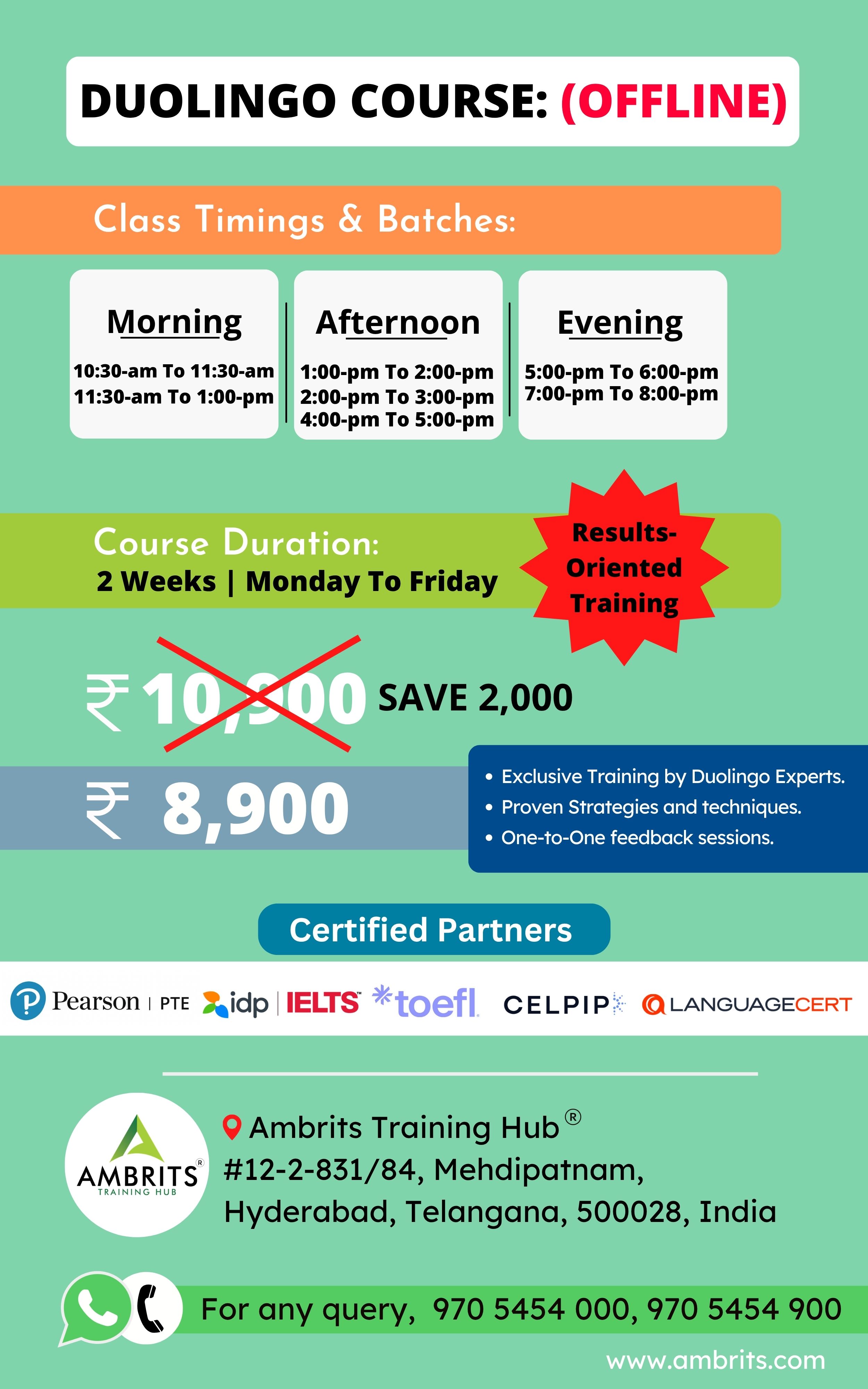
- Duration: 2 weeks, Monday to Friday
- Batch timings: Morning (10:30–11:30 AM or 11:30 AM–1:00 PM), Afternoon (1:00–2:00 PM, 2:00–3:00 PM or 4:00–5:00 PM), Evening (5:00–6:00 PM or 7:00–8:00 PM)
- Course fee: ₹8,900 (down from ₹10,900)
Frequently Asked Questions
How long is the Duolingo course, and what are the batch timings?
2 weeks, Monday to Friday. Morning batches run 10:30–11:30 AM or 11:30 AM–1:00 PM; afternoon 1:00–2:00 PM, 2:00–3:00 PM or 4:00–5:00 PM; evening 5:00–6:00 PM or 7:00–8:00 PM.
What makes the Duolingo English Test different?
It's a computer-adaptive test taken from home rather than at a test center, with results typically available faster than traditional exams — so understanding the at-home test setup (camera rules, environment checks) matters as much as the content itself.
Is the Duolingo English Test accepted by universities?
Yes, it's accepted by thousands of universities and colleges worldwide as an alternative to IELTS or TOEFL for admissions.
Course Brochure